
Resources

Chief Academic Officer Toolkit
South Carolina’s role-specific HQIM toolkits give every district and school a shared set of practical resources to adopt, launch, and sustain high-quality instructional materials. Our theory of action is simple: when educators skillfully implement HQIM, student learning, outcomes, and experiences improve. Your leadership is the catalyst. These tools help you coach, plan, and problem-solve so teachers are equipped to use HQIM with confidence and consistency.
Guidance for Use
This toolkit provides resources for you, the Chief Academic Officer, to lead districtwide implementation of HQIM. Your role involves setting the vision, defining expectations for principals, and monitoring progress to drive consistent, high-quality instruction across the district. Per your role description, you should use these materials to:
- Set clear expectations and norms for professional learning, observations/feedback, coaching, and planning, ensuring role clarity for all educators.
- Establish non-negotiable elements for HQIM usage (“must-haves”) and identify elements teachers may customize without detracting from curriculum integrity.
- Direct building leaders to conduct school-wide step back meetings quarterly and schedule district-wide step back meetings to compile and analyze implementation information for refinement.
- Use classroom observation trend data and student performance data to identify district-level professional learning needs and target areas for improvement.
Vision for Instruction
Vision for Literacy Instruction
Every student in South Carolina will become a confident, capable reader and communicator. Learners will engage with complex, knowledge-building texts and develop their ability to write and speak about them, supported by high-quality materials and strengthened Tier 1 instruction. Early grades will emphasize foundational literacy skills to accelerate reading growth in later years, ensuring students are prepared for grade-level content as measured by end-of-year assessments. Personalized interventions, such as small-group instruction and one-on-one tutoring, will provide targeted support, equipping all learners with the skills needed for academic success. Additionally, students will benefit from an integrated support system that includes ongoing family engagement and access to resources aligned with HQIM.
Vision for Math Instruction
Every student in South Carolina deserves access to meaningful math learning that builds confidence, strengthens reasoning skills, and supports post-secondary success. In all K–12 math classrooms across the state, students will use high-quality, standards-aligned math materials to build deep conceptual understanding and problem-solving skills. They will discuss, write, and reason about mathematical ideas, applying their knowledge to real-world problems. Teachers will facilitate learning to develop procedural fluency and critical thinking, ensuring all students achieve mastery of grade-level content. Additionally, students will benefit from an integrated support system that includes ongoing family engagement and access to resources.
Connection to the Curriculum Support Guide
Research shows that high-quality instructional materials improve student learning. When teachers have high-quality instructional materials, they can focus their time, energy, and creativity on meeting the diverse needs of students, helping all students learn and grow. However, teachers need much more than a new box of materials, even if the materials are great, to engage all students. They need a framework to follow, which is why we created the Curriculum Support Guide (CSG). The CSG is a mental model for the different elements of the curriculum selection and implementation process. There are three distinct phases: selecting great materials, preparing to launch them, and teaching with the materials and learning how to use them well.
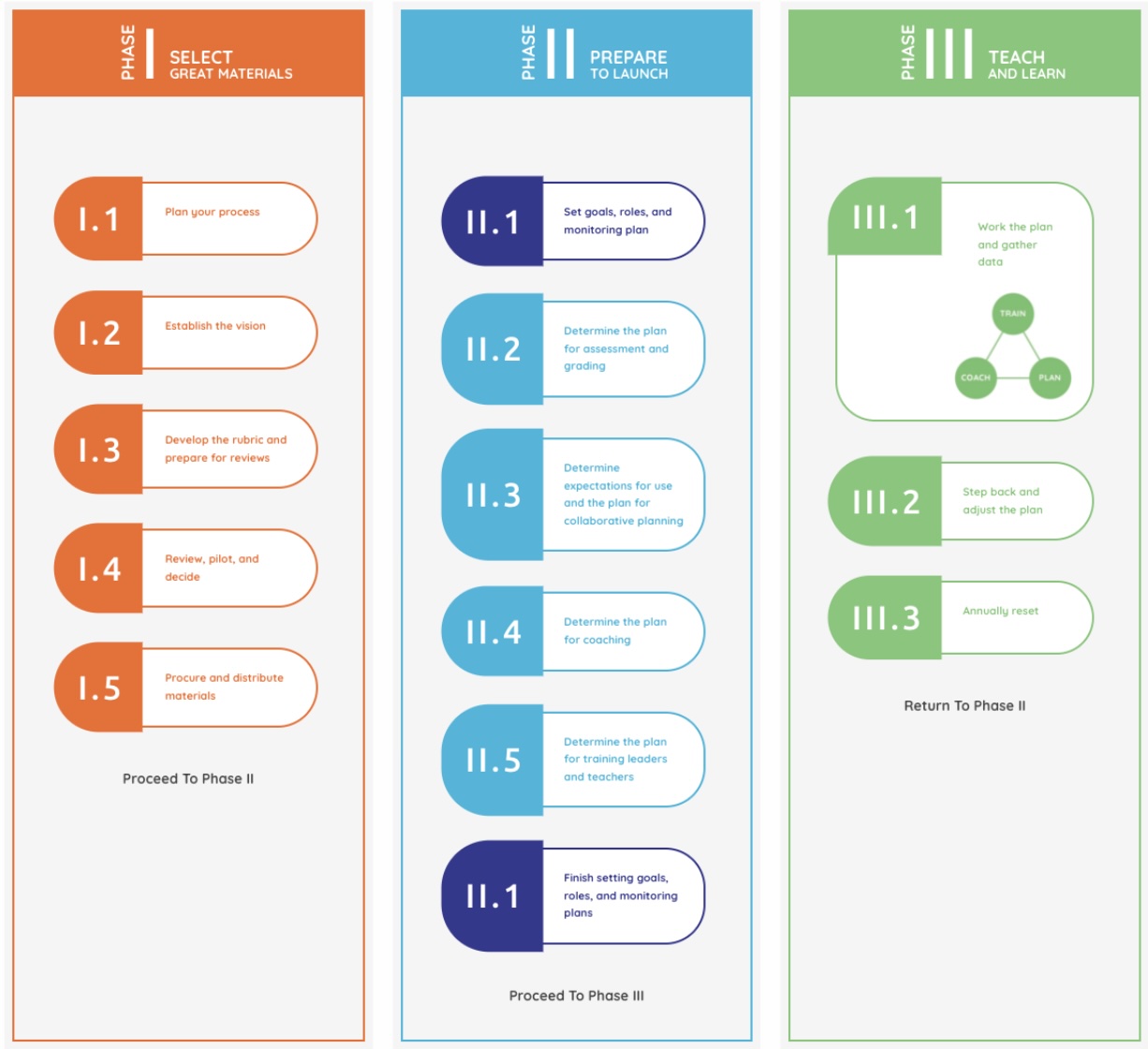
This toolkit focuses on Phase 2 of the Curriculum Support Guide (CSG), which is designed to prepare schools to launch new instructional materials. Phase 2 highlights several critical moments for a successful implementation. Phase 3 includes key moments that push leaders to step back and reflect on current HQIM implementation practices and how to improve those over time.
Key Components of Phase 2
- Establish Expectations for Use: Define and agree on the “must-have” and “customizable” components of the curriculum every teacher will include in each unit and lesson. These expectations are not meant to standardize instruction, but they ensure key elements are consistently used and guide customization choices. These expectations should be set early in the year and reviewed quarterly to make adjustments based on experience.
- Intellectual Preparation: Utilize Curriculum-Based Professional Learning (CBPL) and PLC time to provide teachers with an opportunity to intellectually prepare for an upcoming unit or lesson using their HQIM. These practices are supported by the expectations for use, ensuring the “must-have” components are included.
- Unit internalization helps teachers understand the big ideas, learning arc, and assessment practices within a unit.
- Lesson internalization focuses on intentional daily preparation, including identification of key concepts, anticipation of student needs, and plans for monitoring student learning.
- Coaching and Feedback: Teachers should receive ongoing support. This includes informal observations with actionable feedback on strengths and growth areas as well as strategic support embedded within PLC opportunities. For targeted support, coaches should engage in focused coaching cycles with individual teachers.
Connecting to Phase 3: Monitoring and Adjusting
The final priority moment in curriculum implementation is in Phase 3 of the CSG: holding quarterly step-back meetings to review implementation data is critical to successful implementation. These sessions allow leaders to determine what is working and what needs to be changed to better support teachers and students. These meetings inform modifications to the expectations for use, internalization practices, and coaching support.
Teachers
Role: Deliver instruction using high-quality instructional materials, regularly reflect on practice and student learning, and plan collaboratively to meet the needs of all learners.
Key actions:
- Deliver quality instruction grounded in HQIM, regularly reflecting on practice and student learning.
- Engage fully in coaching sessions, using observation feedback to reflect, identify action steps, and strengthen instructional practices.
- Collaborate with peers to prepare for unit and lesson delivery.
- Analyze student work and assessment data to identify and support students with additional needs, including targeted support for struggling students.
- Communicate regularly with families about student progress and learning.
Principals
Role: Create and sustain structures for strong HQIM implementation by ensuring coaches are supported in guiding and leading teachers, including setting expectations and providing tools for coaches.
Key actions:
- Create day-to-day structures that enable HQIM implementation, including scheduling, facilitating access, and focusing responsibilities.
- Provide teachers with dedicated planning time to collaborate on lesson and unit preparation aligned to HQIM.
- Conduct classroom observations alongside coaches, using the SCDE classroom observation tool for math or ELA, observing key actions related to content and HQIM, teacher moves, and student learning.
- Share observation feedback alongside coaches, with evidence tied to look-fors and specific notes or examples that can support reflection and improvement.
- Emphasize the value and focus of classroom observations and collaborative learning and planning, building a culture of trust in the building.
- Set clear expectations for coaches and hold coaches accountable for providing support, including helping identify teachers in need of coaching support.
- Use classroom observation data within the building or a grade level to identify trends, content-area needs, and professional learning or coaching focus areas.
- Communicate with families about curriculum expectations, instructional focus, and progress at the school level.
School-Based Coach (Coaches)
Role: Guide and support teachers in delivering strong instruction using HQIM by observing and giving feedback, and leading regular collaborative data analysis and planning sessions.
Key actions:
- Lead both group professional learning for all teachers and individual coaching sessions tailored to teacher needs.
- Identify teachers requiring the most support and create individualized coaching plans that outline focus areas, action steps, and follow-up.
- Schedule non-evaluative observations that are aligned with principal and district leader expectations.
- Conduct regular classroom observations using the SCDE classroom observation tool for math or ELA. Observe key actions related to content and HQIM, teacher moves, and student learning. Provide feedback and use data as part of the coaching cycle and protocol.
- Share observation feedback with teachers, with evidence tied to look-fors and specific notes or examples that can support reflection and improvement.
- Track teacher growth across multiple observations, documenting progress over time.
- Facilitate teacher collaboration on unit and lesson preparation, using SCDE-provided tools and protocols.
- Support teachers in analyzing student work and assessments to support identification and planning for students with additional needs.
District Leaders
Role: Set the vision for HQIM implementation by defining expectations for principals, ensuring all have relevant training, and monitoring progress.
Key actions:
- Align resources, including funding, personnel, and time, to support professional learning, classroom observations, coaching, and collaborative planning aligned with procured HQIM.
- Set clear expectations and norms for professional learning, observations/feedback, coaching, collaborative planning, and family engagement, while ensuring role clarity for all educators.
- Ensure training for new teachers and coaches, as well as provide for ongoing support around key responsibilities.
- Use classroom observation trend data, student performance data, and broader district-level data systems to identify professional learning needs and target areas for improvement.
- Develop a professional learning calendar that equips all educators involved in HQIM implementation to fulfill their responsibilities successfully.
- Ensure families have an accurate and complete understanding of their student’s progress.
State-Based Coaches
Role: Strengthen the implementation of HQIM in assigned schools by building the capacity of principals, school-based coaches, and instructional leadership teams to ensure consistent, high-quality instruction in math and literacy.
Key actions:
- Focus coaching on HQIM implementation.
- Ensure alignment between SCDE guidance, training, coaching, and expectations communicated to districts and schools.
- Support principals in setting clear expectations for the use of SCDE-provided classroom observation tools and protocols in the HQIM toolkit.
- Document progress on HQIM implementation using SCDE data collection tools.
- Partner with principals to establish day-to-day structures that enable strong HQIM implementation.
- Co-observe classrooms with principals and school-based coaches, modeling the effective use of SCDE tools, and provide feedback on both instructional practice and observation/feedback practices.
- Coach principals and school-based coaches on using observation and assessment data to identify trends, set priorities, and design professional learning or coaching focus areas.
- Provide targeted coaching to school-based coaches on their coaching and facilitation practices.
- Co-plan and co-facilitate professional learning and data meetings with school-based coaches to strengthen their teacher practices, including teacher collaboration on unit and lesson preparation, using SCDE-provided tools and protocols.
- Help principals and coaches identify patterns of teacher need and develop schoolwide and individual coaching plans that prioritize support for teachers requiring the most assistance.
- Lead cross-school and cross-district professional learning for principals and school-based coaches to share best practices and address implementation challenges.
- Serve as a thought partner for principals on scheduling, staffing, and resource allocation decisions that support HQIM.
After the vision and curriculum for ELA and math are selected, teachers and leaders will define expectations for how to use the curriculum. Using the school’s vision as a guide, they’ll decide on the “must-have” and “customizable” elements at the unit and lesson level.
The “must-have” list will define what it means to implement their HQIM and will guide curriculum-based professional learning and planning. The resources provided below will help leaders facilitate this meeting and ensure everyone’s voice is heard.
The expectations for use will be revisited during quarterly step back meetings and will be adjusted each quarter based on the vision for math and ELA and the implementation experiences of teachers.
Chief Academic Officers and district-wide leadership teams have an important role in the development of expectations for use of the HQIM, as support for establishing and implementing these expectations must have top- down calibration to ensure clarity and focus among instructional staff. For this process to run smoothly, Chief Academic Officers should provide guidance for the district leadership to use the districtwide instructional priorities to establish some non-negotiable elements that should be a part of the expectations for use; these should be curricular elements that are fundamental to content instruction and should be part of the “must-haves” for HQIM usage. In addition, the Chief Academic Officer should guide district leadership teams to identify the elements of the HQIM that teachers may customize without detracting from the integrity of the curriculum and content. In preparation for the expectations for use sessions, the Chief Academic Officer guides and supports the district leaders in establishing a clear process for developing the expectations for use of their HQIM (such as the one described in this toolkit), and communicating that process to building leaders and coaches to ensure there is a consistent approach and process for establishing the expectations across the district.
After the expectations for use sessions are complete, Chief Academic Officers should direct leaders from each building to submit the notes and decisions from the session for review to oversee the district leadership in identifying trends and commonalities across buildings, grade levels, and teams. District leaders should then stamp the drafted expectations for use by ensuring alignment with the “must-haves” and “customizations” they identified within the HQIM to ensure consistent implementation of the curriculum across the district. Under guidance from the Chief Academic Officer, district leadership should ensure these expectations are clearly communicated to all instructional staff and support building leaders in creating a plan to ensure teachers adhere to the expectations that are set. Finally, with guidance from the Chief Academic Officer, district leadership should support building principals in holding a quarterly review of the expectations for use of the HQIM to gather feedback, collect questions, and identify any modifications that need to be made to the “must-haves” and “customizations.”
Expectations for Use Slides with Facilitator’s Guide and Note Catcher
After the vision and expectations for use are established and shared with all stakeholders, leaders and teachers will engage in intellectual preparation processes with their HQIM. Intellectual preparation is an essential part of HQIM internalization, on both the unit and lesson levels (see Figure 1). Although all of Figure 1 could occur during PLC time, the initial unit and lesson internalization sessions should occur during separate curriculum-based professional learning time because these sessions typically last between two to three hours.
Figure 1
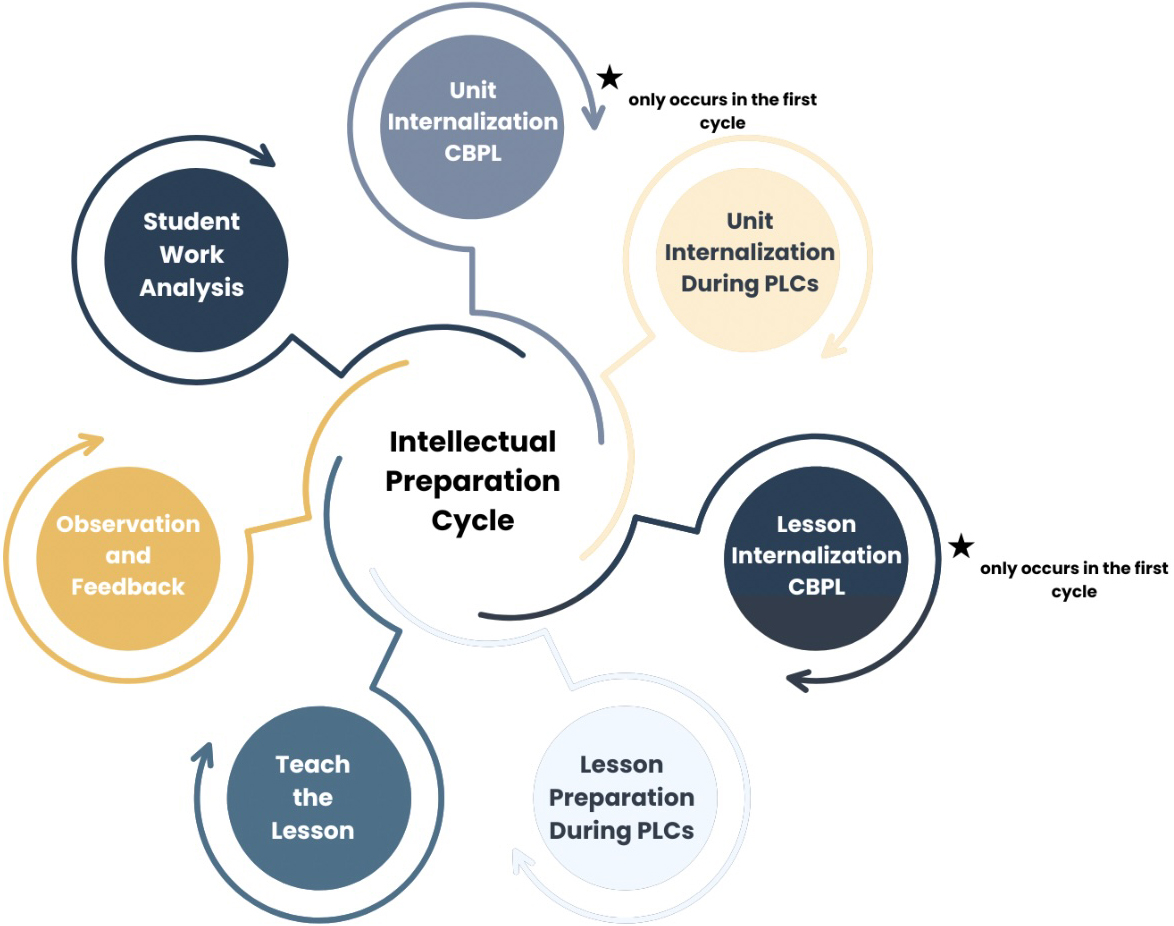
*Coaches and teachers may engage with the following stages multiple times within the same Unit: “lesson preparation during PLCs,” “teach the lesson,” “observation and feedback,” and “student work analysis during PLCs.”
Unit and lesson internalization CBPL sessions aim to provide leaders and teachers with the opportunity to intentionally engage with their curricular materials to understand the key components available prior to delivering instruction. Additional items in Figure 1 are more brief and require collaboration between team members. The items in Figure 1 occur in the following order:
- Unit Internalization CBPL: This should happen first so teachers have an opportunity to explore various resources and elements available to them as part of their HQIM. The school-based coach will facilitate the first session for teachers to build their capacity for the process. This should occur once or, if needed, twice a year. The purpose of this session is to help teachers understand the key concepts and learning arc of a unit. By examining end-of-unit assessments and reading the unit narrative, teachers can identify key learning moments and focus their instruction.
Initial Math CBPL—Unit Internalization Slides with Facilitator’s Guide and Note Catcher
Initial ELA CBPL—Unit Internalization Slides with Facilitator’s Guide and Note-Catcher
- Unit Internalization Planning During PLCs: This happens after teachers are familiar with the unit internalization process and occurs during PLC time when teachers are beginning a new unit in their HQIM. This gives teachers the opportunity to explore the key understandings of the upcoming unit, discuss with their peers, and use the unit internalization process introduced during CBPL. Engaging in the unit planning process before lesson internalization allows teachers to see how each lesson fits into the unit and how the learning connects and builds over time.
Sample PLC Agenda and Note Catcher (Ongoing Unit Planning)
- Lesson Internalization CBPL: This occurs after teachers engage in the unit internalization process. After teachers have an understanding of the unit resources, they can zoom in and focus on the components of a lesson. During this time, the school-based coach supports teachers in leveraging best practices when planning and internalizing HQIM lessons. This should occur once or, if needed, twice a year. The purpose of this session is to provide teachers with a focused look at a single lesson while connecting it to the overall unit. Teachers will examine the lesson to identify its learning objectives and corresponding standards. Using the established expectations for use, teachers can then pinpoint the “must-have” elements—the essential parts of the lesson that must be addressed, even if time is limited. Additionally, this process helps teachers plan for student support, whether by building background knowledge or extending learning.
Initial Math CBPL—Lesson Internalization Slides with Facilitator’s Guide and Note Catcher
Initial ELA CBPL—Lesson Internalization Slides with Facilitator’s Guide and Note Catcher
- Lesson Internalization Planning During PLCs: After teachers engage in the lesson internalization CBPL session, they can regularly use that protocol during PLCs to collaboratively plan upcoming HQIM lessons. This gives teachers the opportunity to continue to utilize the internalization process to intentionally plan grade-appropriate lessons for their students.
Sample PLC Agenda and Note Catcher (Ongoing Lesson Planning)
- Teach the Lesson: Teachers should implement the lesson as planned during the lesson internalization PLC. When possible, the school-based coach observes the lesson and collects quantitative and qualitative data during the implemented lesson to inform discussion points for coaching conversations, along with upcoming PLC topics.
- Observation and Feedback: After the school-based coach observes the implemented lesson, it is important to meet with teachers within a reasonable amount of time to discuss the data they collected. Feedback should be affirmative and positive, but include one thing to work on during unit and/or lesson planning to improve instruction. Feedback should be actionable, and the coach should monitor to ensure teachers incorporate it into future instruction. During debriefs of classroom observations, the teacher and the coach should engage in a conversation that provides the teacher with the opportunity to ask clarifying questions, practice explanations, and give input from both the teacher and the coach on next steps to continue to grow instructional practices. When there are common areas of opportunity in instruction, the coach should notate the opportunity and incorporate it into PLC time.
- Student Work Analysis During PLCs: After teachers have engaged in the unit and lesson internalization, curriculum-based professional learning sessions, and used these processes during PLCs, they should analyze student work. School-based coaches create a system for this process so teachers can regularly discuss strengths in a lesson, challenges students encountered during the lesson, and potential pathways to strengthen instruction. It is important that teachers bring work samples to these PLC meetings so their conversations can be grounded in the analysis of actual student data. For the student work analysis, school-based coaches will be responsible for communicating to teachers the student work they should bring from the HQIM instruction to the PLC meeting and then guiding them through this analysis process by giving them opportunities to reflect on the instructional implications of the data, consider their implementation practices, and adjust their planning and delivery accordingly.
Student Work Analysis Protocol and Agenda/Note Catcher
As coaches support teachers with intellectual preparation protocols, students in South Carolina will receive rigorous, meaningful, and grade-appropriate instruction.
In order to implement the HQIM with integrity, strong habits of intellectual preparation are necessary, and this requires direction and support from the Chief Academic Officer and district leadership to provide the systems and conditions necessary to maximize the time in PLC sessions. Under the guidance of the Chief Academic Officer, district leaders should adopt or adapt a clear vision for the purpose, structure, and impact of intellectual preparation during CBPL and PLC sessions to elicit teacher buy-in and create a consistent focus on intellectual preparation across the district. Another essential condition to enable the effectiveness of CBPLs and PLCs is time; principals and building leaders need direction from the Chief Academic Officer and district leadership team to provide dedicated, protected, and consistent time for teachers to meet regularly to engage in collaborative intellectual preparation. District leadership, with input and guidance from the Chief Academic Officer, should instruct the building leaders to provide a consistent amount of time and a consistent cadence for Intellectual Preparation during CBPLs and PLCs.
The Chief Academic Officer and district leaders must adopt or adapt specific processes for intellectual preparation, such as the habits and key moves described above for unit and lesson internalization and student work analysis, and ensure all participants have the training necessary to use the protocols for planning. Also, the Chief Academic Officer should instruct district leaders to clearly communicate the expectation to use the adopted internalization and student work analysis methods to build leadership and teachers, ensuring a consistent process is used for implementation of the HQIM across schools in the district. Effective intellectual preparation also requires facilitators who are trained and willing to take on that role, so district leadership should provide training for the facilitators of the processes for internalization and student work analysis to ensure the meetings have a consistent process, run smoothly, and have a strong focus on intentionally planning for implementation of the HQIM.
In order to monitor the effectiveness of intellectual preparation during PLC sessions, the Chief Academic Officer and district leadership should encourage building leaders to attend CBPL and PLC meetings as regularly as possible to ensure the time allocated for them is being used effectively to focus on intellectual preparation for delivery of instruction using the HQIM, and the Chief Academic Officer and district leaders should instruct building leaders to prioritize acting as lead learners by participating in the sessions they join. Finally, the Chief Academic Officer should direct district leaders to periodically collect data on the intellectual preparation that is occurring during CBPLs and PLCs by observing the sessions, surveying teachers, and/or analyzing student performance data for growth and improvement trends aligned with the intellectual preparation processes.
To support teachers and monitor the implementation of HQIM, school and district leaders can use an observation tool.
The resources below include specific tools and guidance for both math and ELA walkthroughs. These tools are designed to help leaders identify strengths and areas for improvement for each teacher in a supportive, non-evaluative way.
These observation tools used during walkthroughs are not for evaluation. They should be used to:
- gather a snapshot of instruction across the entire school, and
- support a specific coaching cycle for an individual teacher.
School-wide walkthroughs should happen at least once per quarter, with additional walkthroughs scheduled based on teacher needs.
With guidance from the Chief Academic Officer, district leadership teams should set expectations for observation and feedback. There should be district-wide expectations around the cadence of school- wide walkthroughs, the use of the observation companion, and feedback protocols to establish consistent experiences across the district. After these expectations are clearly defined with input from the Chief Academic Officer, building leaders and school-based coaches should receive clear communication outlining these guidelines.
While the school-wide walkthroughs provide leaders with data to identify trends and opportunities for growth at the building level, it is also important to gather that data at the district level. District-wide walkthroughs provide insight into the effectiveness of HQIM implementation and instructional delivery. The Chief Academic Officer and district leadership teams should plan to visit a sampling of classrooms at each building at least once per semester to gather observation data at the district level. After a round of district-wide walkthroughs, the Chief Academic Officer and district leadership team should engage in a debrief with the building leadership to norm on trends and implications drawn from the walkthroughs. Finally, the Chief Academic Officer should direct the district leadership team to analyze observation data from building leaders and their own visits to draw high-level conclusions and determine next steps for the district in implementing the HQIM.
Math Observation Tool, Math Observation Companion, and Digital Math Observation Tool
ELA Observation Tool, ELA Observation Companion, and Digital ELA Observation Tool
Foundational Literacy Observation Tool, Foundational Literacy Companion, and Digital Foundational Literacy Observation Tool
A key responsibility of school coaches is to support teachers by affirming successful practices while also providing opportunities for growth. Coaching cycles are an effective way to provide this targeted support using the stages of the coaching cycle linked below in this section of the Toolkit. Additional visual representations of the stages of the coaching cycle can be found in Figures 2 and 3 below.
Figure 2
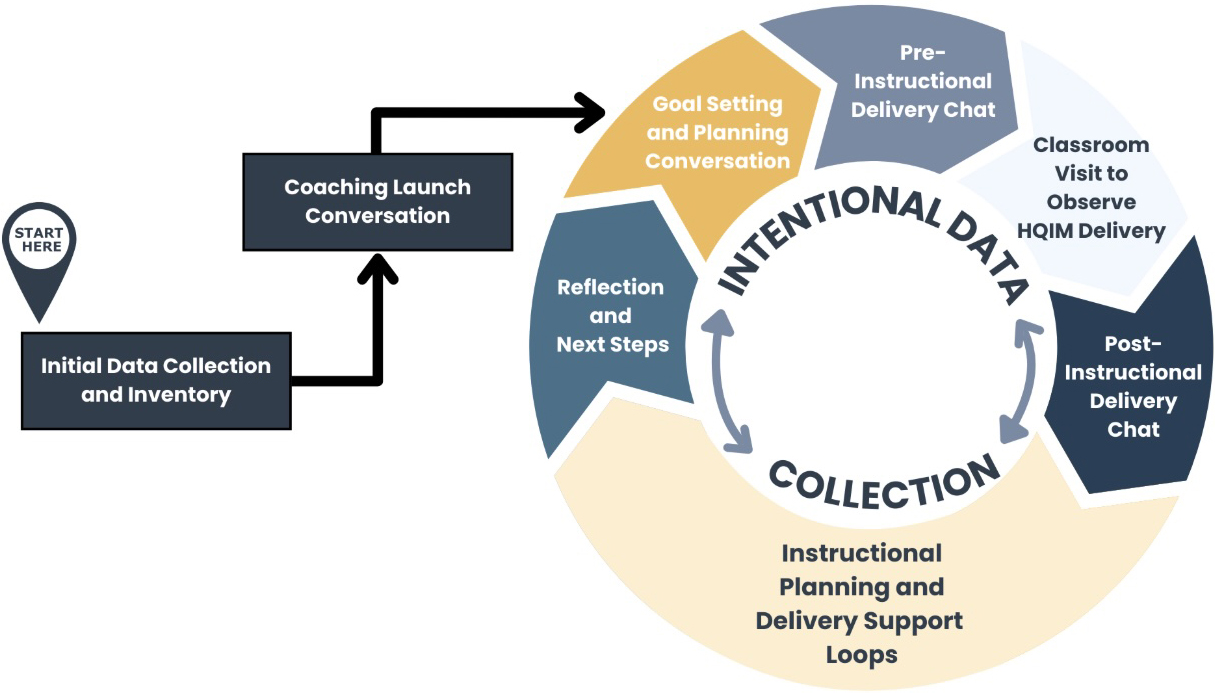
Figure 3
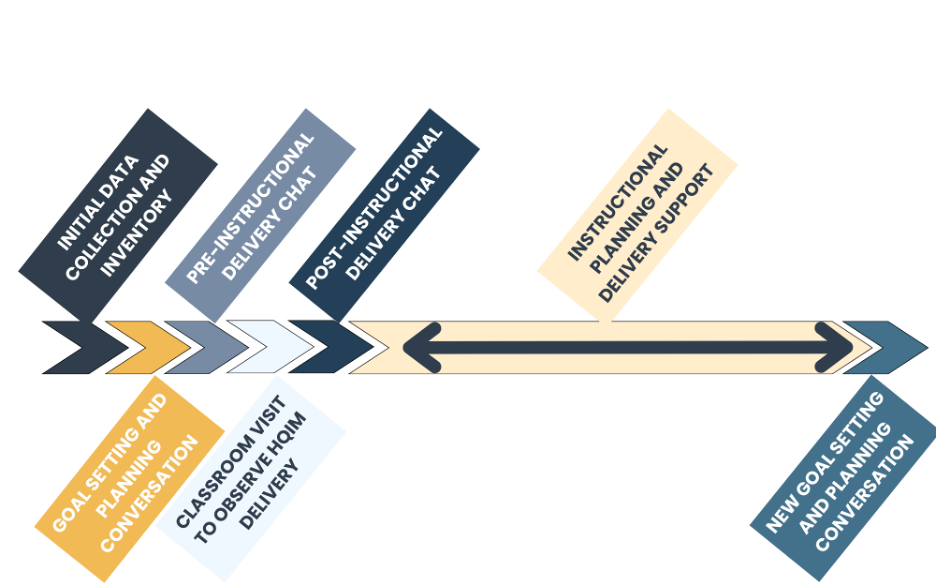
These coaching cycles, similar to those developed by Jim Knight (The Impact Cycle) and Elena Aguilar (The Art of Coaching), outline a structured way to provide goal-centered and in-depth support to all teachers. These cycles are not about fixing what is wrong; they are about leveraging relationships between coaches and teachers to build on and expand existing knowledge and capabilities into additional instructional strengths.
The focus of a coaching cycle should be a specific element of the curriculum (such as discussion questions or synthesis activities) or an instructional practice (such as questioning or giving academic feedback). Instead of giving directives, coaches drive the conversation with teachers using open-ended questions that encourage growth and reflection.
The duration of the coaching cycle may be different from teacher to teacher. However, coaches and teachers will likely engage in multiple rounds of cycles throughout the school year. The length of the cycles will depend on how quickly a teacher makes progress toward their identified goals and logical next steps to continue to strengthen their instruction.
In order to ensure teachers receive necessary coaching and support with planning and delivering instruction from the HQIM, the Chief Academic Officer, along with district leadership, should ensure the district has a clear definition and vision of instructional coaching that is clearly communicated district-wide. In defining and crafting a vision for coaching, Chief Academic Officers should guide district leaders to clarify the district-wide approach to coaching that should be used in all buildings and provide learning opportunities and training support for building leadership and school-based coaches to learn and practice the coaching cycle work within the approach to instructional coaching adopted by the district.
Additionally, the Chief Academic Officer should work with finance officers within the district to ensure there is adequate funding for instructional coaching and allocate coaching resources to support the coaches at each building to prioritize instructional coaching across the district. District leadership should communicate regularly with school-based coaches and building leaders to ascertain any common trends in the coaching work, along with some district-wide implications for curriculum-based professional learning. In addition to this informal communication, within the step back meetings described in sustaining practices, the Chief Academic Officer should include time to discuss and assess the effectiveness and impact of HQIM coaching work through multiple data points. These data points can include, but are not limited to, surveying stakeholders on coaching efficacy, reviewing coaching logs, speaking with coaches and teachers, and analyzing student performance data.
To ensure these practices are successfully implemented, leaders must create structures that support continuous growth. The resources below include tools for facilitating quarterly step back meetings and sample PLC and CBPL calendars to help protect time for key activities. Every educator is responsible for implementing HQIM, but it is ultimately the leaders’ responsibility to create the conditions for success.
After initial implementation of the curriculum, the Chief Academic Officer should direct district leaders to continue to keep apprised of the effectiveness, efficiency, and impact of the HQIM to determine steps they can take at the district level to build on successes and provide curriculum-based professional learning for areas for growth. Under the guidance of the Chief Academic Officer, district leadership should identify and prioritize time for district-wide CBPL centered around instructional focus areas for the district within math and ELA. After these sessions, the Chief Academic Officer and district leaders should collaborate to determine and allocate follow-up resources to building leaders and set accountability measures for the use of the learning during the CBPL.
Finally, the Chief Academic Officer should direct building leaders to conduct school-wide step back meetings to uncover successes and challenges with the implementation of the HQIM once per quarter and guide district leaders to schedule district-wide step back meetings that bring together representation from different grade levels, schools, and perspectives on the implementation of the HQIM. After these sessions, the Chief Academic Officer should facilitate district leadership meetings to compile and analyze the information gathered at the building-wide step back meetings to draw conclusions about next steps and continued refinement of the HQIM curriculum implementation.
Step Back Meeting Agenda and Email
Sample PLC Schedules
Sample Year-Long CBPL Calendars
Sample Bell Schedules
Principal Toolkit
South Carolina role-specific toolkits will be available to all districts and schools to support the implementation of High-Quality Instructional Materials (HQIM). This toolkit is designed to provide a common set of resources for all South Carolina educators. The goal is to support educators in gaining confidence while adopting, launching, and sustaining HQIM in their school and/or district by having easily accessible resources. HQIM is considered an equalizer that will best improve student learning, outcomes, and experiences.
Guidance for Use
This toolkit provides resources for you, the principal, to lead the implementation of HQIM in your school. Your role involves creating and sustaining structures for strong HQIM implementation by ensuring coaches are supported in guiding and leading teachers, including setting expectations and providing tools for coaches. Per your role description, you should use these materials to:
- Create day-to-day structures that enable HQIM implementation, including scheduling and providing teachers with dedicated collaborative planning time.
- Set clear expectations for coaches and hold them accountable for supporting teachers.
- Conduct classroom observations alongside coaches using the SCDE tool and share observation feedback to support reflection and improvement.
- Use classroom observation data within the building or grade level to identify trends and focus areas for professional learning.
- Attend intellectual preparation meetings to understand instruction, show investment, and ensure teacher-identified “must-haves” align with school and district priorities.
Vision for Instruction
Vision for Literacy Instruction
Every student in South Carolina will become a confident, capable reader and communicator. Learners will engage with complex, knowledge-building texts and develop their ability to write and speak about them, supported by high-quality materials and strengthened Tier 1 instruction. Early grades will emphasize foundational literacy skills to accelerate reading growth in later years, ensuring students are prepared for grade-level content as measured by end-of-year assessments. Personalized interventions, such as small-group instruction and one-on-one tutoring, will provide targeted support, equipping all learners with the skills needed for academic success. Additionally, students will benefit from an integrated support system that includes ongoing family engagement and access to resources aligned with HQIM.
Vision for Math Instruction
Every student in South Carolina deserves access to meaningful math learning that builds confidence, strengthens reasoning skills, and supports post-secondary success. In all K–12 math classrooms across the state, students will use high-quality, standards-aligned math materials to build deep conceptual understanding and problem-solving skills. They will discuss, write, and reason about mathematical ideas, applying their knowledge to real-world problems. Teachers will facilitate learning to develop procedural fluency and critical thinking, ensuring all students achieve mastery of grade-level content. Additionally, students will benefit from an integrated support system that includes ongoing family engagement and access to resources.
Connection to the Curriculum Support Guide
Research shows that high-quality instructional materials improve student learning. When teachers have high-quality instructional materials, they can focus their time, energy, and creativity on meeting the diverse needs of students, helping all students learn and grow. However, teachers need much more than a new box of materials, even if the materials are great, to engage all students. They need a framework to follow, which is why we created the Curriculum Support Guide (CSG). The CSG is a mental model for the different elements of the curriculum selection and implementation process. There are three distinct phases: selecting great materials, preparing to launch them, and teaching with the materials and learning how to use them well.
This toolkit focuses on Phase 2 of the Curriculum Support Guide (CSG), which prepares schools to launch new instructional materials. Phase 2 highlights several critical moments for a successful implementation. Phase 3 includes key moments that push leaders to step back and reflect on current HQIM implementation practices and how to improve those over time.
Key Components of Phase 2
- Establish Expectations for Use: Define and agree on the “must-have” and “customizable” components of the curriculum every teacher will include in each unit and lesson. These expectations are not meant to standardize instruction, but they ensure key elements are consistently used and guide customization choices. These expectations should be set early in the year and reviewed quarterly to make adjustments based on experience.
- Intellectual Preparation: Utilize Curriculum-Based Professional Learning (CBPL) and PLC time to provide teachers with an opportunity to intellectually prepare for an upcoming unit or lesson using their HQIM. These practices are supported by the expectations for use, ensuring the “must-have” components are included.
- Unit internalization helps teachers understand the big ideas, learning arc, and assessment practices within a unit.
- Lesson internalization focuses on intentional daily preparation, including identification of key concepts, anticipation of student needs, and plans for monitoring student learning.
- Coaching and Feedback: Teachers should receive ongoing support. This includes informal observations with actionable feedback on strengths and growth areas as well as strategic support embedded within PLC opportunities. For targeted support, coaches should engage in focused coaching cycles with individual teachers.
Connecting to Phase 3: Monitoring and Adjusting
The final priority moment in curriculum implementation is in Phase 3 of the CSG: holding quarterly step-back meetings to review implementation data is critical to successful implementation. These sessions allow leaders to determine what is working and what needs to be changed to better support teachers and students. These meetings inform modifications to the expectations for use, internalization practices, and coaching support.
Teachers
Role: Deliver instruction using high-quality instructional materials, regularly reflect on practice and student learning, and plan collaboratively to meet the needs of all learners.
Key actions:
- Deliver quality instruction grounded in HQIM, regularly reflecting on practice and student learning.
- Engage fully in coaching sessions, using observation feedback to reflect, identify action steps, and strengthen instructional practices.
- Collaborate with peers to prepare for unit and lesson delivery.
- Analyze student work and assessment data to identify and support students with additional needs, including targeted support for struggling students.
- Communicate regularly with families about student progress and learning.
Principals
Role: Create and sustain structures for strong HQIM implementation by ensuring coaches are supported in guiding and leading teachers, including setting expectations and providing tools for coaches.
Key actions:
- Create day-to-day structures that enable HQIM implementation, including scheduling, facilitating access, and focusing responsibilities.
- Provide teachers with dedicated planning time to collaborate on lesson and unit preparation aligned to HQIM.
- Conduct classroom observations alongside coaches, using the SCDE classroom observation tool for math or ELA, observing key actions related to content and HQIM, teacher moves, and student learning.
- Share observation feedback alongside coaches, with evidence tied to look-fors and specific notes or examples that can support reflection and improvement.
- Emphasize the value and focus of classroom observations and collaborative learning and planning, building a culture of trust in the building.
- Set clear expectations for coaches and hold coaches accountable for providing support, including helping identify teachers in need of coaching support.
- Use classroom observation data within the building or at the grade level to identify trends, content-area needs, and professional learning or coaching focus areas.
- Communicate with families about curriculum expectations, instructional focus, and progress at the school level.
School-Based Coach (Coaches)
Role: Guide and support teachers in delivering strong instruction using HQIM by observing and giving feedback, and leading regular collaborative data analysis and planning sessions.
Key actions:
- Lead both group professional learning for all teachers and individual coaching sessions tailored to teacher needs.
- Identify teachers requiring the most support and create individualized coaching plans that outline focus areas, action steps, and follow-up.
- Schedule non-evaluative observations that are aligned with principal and district leader expectations.
- Conduct regular classroom observations using the SCDE classroom observation tool for math or ELA. Observe key actions related to content and HQIM, teacher moves, and student learning. Provide feedback and use data as part of the coaching cycle and protocol.
- Share observation feedback with teachers, with evidence tied to look-fors and specific notes or examples that can support reflection and improvement.
- Track teacher growth across multiple observations, documenting progress over time.
- Facilitate teacher collaboration on unit and lesson preparation, using SCDE-provided tools and protocols.
- Support teachers in analyzing student work and assessments to support identification and planning for students with additional needs.
District Leaders
Role: Set the vision for HQIM implementation by defining expectations for principals, ensuring all have relevant training, and monitoring progress.
Key actions:
- Align resources, including funding, personnel, and time, to support professional learning, classroom observations, coaching, and collaborative planning aligned with procured HQIM.
- Set clear expectations and norms for professional learning, observations/feedback, coaching, collaborative planning, and family engagement, while ensuring role clarity for all educators.
- Ensure training for new teachers and coaches, as well as provide for ongoing support around key responsibilities.
- Use classroom observation trend data, student performance data, and broader district-level data systems to identify professional learning needs and target areas for improvement.
- Develop a professional learning calendar that equips all educators involved in HQIM implementation to fulfill their responsibilities successfully.
- Ensure families have an accurate and complete understanding of their student’s progress.
State-Based Coaches
Role: Strengthen the implementation of HQIM in assigned schools by building the capacity of principals, school-based coaches, and instructional leadership teams to ensure consistent, high-quality instruction in math and literacy.
Key actions:
- Focus coaching on HQIM implementation.
- Ensure alignment between SCDE guidance, training, coaching, and expectations communicated to districts and schools.
- Support principals in setting clear expectations for the use of SCDE-provided classroom observation tools and protocols in the HQIM toolkit.
- Document progress on HQIM implementation using SCDE data collection tools.
- Partner with principals to establish day-to-day structures that enable strong HQIM implementation.
- Co-observe classrooms with principals and school-based coaches, modeling the effective use of SCDE tools, and provide feedback on both instructional practice and observation/feedback practices.
- Coach principals and school-based coaches on using observation and assessment data to identify trends, set priorities, and design professional learning or coaching focus areas.
- Provide targeted coaching to school-based coaches on their coaching and facilitation practices.
- Co-plan and co-facilitate professional learning and data meetings with school-based coaches to strengthen their teacher practices, including teacher collaboration on unit and lesson preparation, using SCDE-provided tools and protocols.
- Help principals and coaches identify patterns of teacher need and develop schoolwide and individual coaching plans that prioritize support for teachers requiring the most assistance.
- Lead cross-school and cross-district professional learning for principals and school-based coaches to share best practices and address implementation challenges.
- Serve as a thought partner for principals on scheduling, staffing, and resource allocation decisions that support HQIM.
After the vision and curriculum for ELA and math are selected, teachers and leaders will define expectations for how to use the curriculum. Using the school’s vision as a guide, they’ll decide on the “must-have” and “customizable” elements at the unit and lesson level.
The “must-have” list will define what it means to implement their HQIM and will guide curriculum-based professional learning and planning. The resources provided below will help leaders facilitate this meeting and ensure everyone’s voice is heard.
The expectations for use will be revisited during quarterly step back meetings and will be adjusted each quarter based on the vision for math and ELA and the implementation experiences of teachers.
As the principal, you will ensure that time is set aside in the school calendar for the school-based coach to lead the expectations for use meeting with teachers. You will work closely with the school-based coach to prepare them to facilitate this meeting and help them think through the “must-have” elements of the HQIM. You will also support them in crafting questions that will help teachers see the importance and impact of those “must-have” HQIM components. You should attend and be an active participant in the expectations for use meeting to push teacher thinking, as needed. Your perspective will help to ensure the teacher identified “must-haves” align with those of the school-based coach and support district-wide priorities. During quarterly step back meetings, you should revisit these expectations for use, discuss the extent to which the expectations are used, and analyze how the expectations support students in making progress towards learning goals. If adjustments to these expectations for use need to be made after discussing them in step-back meetings, you should collaborate with the school-based coach to revisit the expectations with teachers during PLC time.
Expectations for Use Slides with Facilitator’s Guide and Note Catcher
After the vision and expectations for use are established and shared with all stakeholders, leaders and teachers will engage in intellectual preparation processes with their HQIM. Intellectual preparation is an essential part of HQIM internalization, on both the unit and lesson levels (see Figure 1). Although all of Figure 1 could occur during PLC time, the initial unit and lesson internalization sessions should occur during separate curriculum-based professional learning time because these sessions typically last between two to three hours.
Figure 1
*Coaches and teachers may engage with the following stages multiple times within the same Unit: “lesson preparation during PLCs,” “teach the lesson,” “observation and feedback,” and “student work analysis during PLCs.”
Unit and lesson internalization CBPL sessions aim to provide leaders and teachers with the opportunity to intentionally engage with their curricular materials to understand the key components available prior to delivering instruction. Additional items in Figure 1 are more brief and require collaboration between team members. The items in Figure 1 occur in the following order:
- Unit Internalization CBPL: This should happen first so teachers have an opportunity to explore various resources and elements available to them as part of their HQIM. The school-based coach will facilitate the first session for teachers to build their capacity for the process. This should occur once or, if needed, twice a year. The purpose of this session is to help teachers understand the key concepts and learning arc of a unit. By examining end-of-unit assessments and reading the unit narrative, teachers can identify key learning moments and focus their instruction.
Initial Math CBPL—Unit Internalization Slides with Facilitator’s Guide and Note Catcher
Initial ELA CBPL—Unit Internalization Slides with Facilitator’s Guide and Note-Catcher
- Unit Internalization Planning During PLCs: This happens after teachers are familiar with the unit internalization process and occurs during PLC time when teachers are beginning a new unit in their HQIM. This gives teachers the opportunity to explore the key understandings of the upcoming unit, discuss with their peers, and use the unit internalization process introduced during CBPL. Engaging in the unit planning process before lesson internalization allows teachers to see how each lesson fits into the unit and how the learning connects and builds over time.
Sample PLC Agenda and Note Catcher (Ongoing Unit Planning)
- Lesson Internalization CBPL: This occurs after teachers engage in the unit internalization process. After teachers have an understanding of the unit resources, they can zoom in and focus on the components of a lesson. During this time, the school-based coach supports teachers in leveraging best practices when planning and internalizing HQIM lessons. This should occur once or, if needed, twice a year. The purpose of this session is to provide teachers with a focused look at a single lesson while connecting it to the overall unit. Teachers will examine the lesson to identify its learning objectives and corresponding standards. Using the established expectations for use, teachers can then pinpoint the “must-have” elements—the essential parts of the lesson that must be addressed, even if time is limited. Additionally, this process helps teachers plan for student support, whether by building background knowledge or extending learning.
Initial Math CBPL—Lesson Internalization Slides with Facilitator’s Guide and Note Catcher
Initial ELA CBPL—Lesson Internalization Slides with Facilitator’s Guide and Note Catcher
- Lesson Internalization Planning During PLCs: After teachers engage in the lesson internalization CBPL session, they can regularly use that protocol during PLCs to collaboratively plan upcoming HQIM lessons. This gives teachers the opportunity to continue to utilize the internalization process to intentionally plan grade-appropriate lessons for their students.
Sample PLC Agenda and Note Catcher (Ongoing Lesson Planning)
- Teach the Lesson: Teachers should implement the lesson as planned during the lesson internalization PLC. When possible, the school-based coach observes the lesson and collects quantitative and qualitative data during the implemented lesson to inform discussion points for coaching conversations, along with upcoming PLC topics.
- Observation and Feedback: After the school-based coach observes the implemented lesson, it is important to meet with teachers within a reasonable amount of time to discuss the data they collected. Feedback should be affirmative and positive, but include one thing to work on during unit and/or lesson planning to improve instruction. Feedback should be actionable, and the coach should monitor to ensure teachers incorporate it into future instruction. During debriefs of classroom observations, the teacher and the coach should engage in a conversation that provides the teacher with the opportunity to ask clarifying questions, practice explanations, and give input from both the teacher and the coach on next steps to continue to grow instructional practices. When there are common areas of opportunity in instruction, the coach should notate the opportunity and incorporate it into PLC time.
- Student Work Analysis During PLCs: After teachers have engaged in the unit and lesson internalization, curriculum-based professional learning sessions, and used these processes during PLCs, they should analyze student work. School-based coaches create a system for this process so teachers can regularly discuss strengths in a lesson, challenges students encountered during the lesson, and potential pathways to strengthen instruction. It is important that teachers bring work samples to these PLC meetings so their conversations can be grounded in the analysis of actual student data. For the student work analysis, school-based coaches will be responsible for communicating to teachers the student work they should bring from the HQIM instruction to the PLC meeting and then guiding them through this analysis process by giving them opportunities to reflect on the instructional implications of the data, consider their implementation practices, and adjust their planning and delivery accordingly.
Student Work Analysis Protocol and Agenda/Note Catcher
As coaches support teachers with intellectual preparation protocols, students in South Carolina will receive rigorous, meaningful, and grade-appropriate instruction.
As the principal, you are responsible for creating the structures and conditions necessary for school-based coaches to lead CBPL and PLC meetings throughout the school year. These sessions support the intellectual preparation process, including unit and lesson internalization as well as continued unit and lesson preparation using the HQIM. You are expected to join all intellectual preparation meetings you are able to in order to understand what instruction is happening in classrooms, show your investment in the learning, and support school-based coaches with subsequent PLC meetings and coaching conversations, as needed. As a participant in these meetings, you should actively listen to teacher conversations, push teachers’ thinking, and maintain conversations that are grounded in the curriculum and focus topics. Your attendance at the intellectual preparation sessions will allow you to provide feedback to the school-based coach on their facilitation of the intellectual preparation process, so they can continue to improve their practice as an instructional leader within their role. After providing feedback to the coach, you should observe the coach during subsequent sessions to determine how the feedback is implemented. Finally, your attendance at intellectual preparation sessions will enable you to have a deep understanding of what instruction you should expect to see when observing classrooms, provide teachers with specific feedback, and discuss next steps with the coach.
To support teachers and monitor the implementation of HQIM, school and district leaders can use an observation tool.
The resources below include specific tools and guidance for both math and ELA walkthroughs. These tools are designed to help leaders identify strengths and areas for improvement for each teacher in a supportive, non-evaluative way.
These observation tools used during walkthroughs are not for evaluation. They should be used to:
- gather a snapshot of instruction across the entire school, and
- support a specific coaching cycle for an individual teacher.
School-wide walkthroughs should happen at least once per quarter, with additional walkthroughs scheduled based on teacher needs.
As the principal, you should be well-versed with the indicators on the observation tool in order to join the school-based coach in classroom observations, collect data using the observation tool, discuss strengths and opportunities in specific classrooms, and identify school-wide trends. Additionally, you should expect to share your observation data during debrief conversations led by the school-based coach. Your active participation in these debriefs is essential to ensure that instructional strengths and opportunities for growth are accurately identified, provide thought partnership on next steps, and support the school-based coach in their work with teachers. As the principal, you will also share observation data with other district leaders to collaboratively brainstorm ways to strengthen instruction within your building and across the district.
Math Observation Tool, Math Observation Companion and Digital Math Observation Tool
ELA Observation Tool, ELA Observation Companion, and Digital ELA Observation Tool
Foundational Literacy Observation Tool, Foundational Literacy Observation Companion, and Digital Foundational Literacy Observation Tool
A key responsibility of school coaches is to support teachers by affirming successful practices while also providing opportunities for growth. Coaching cycles are an effective way to provide this targeted support using the stages of the coaching cycle linked below in this section of the Toolkit. Additional visual representations of the stages of the coaching cycle can be found in Figures 2 and 3 below.
Figure 2
Figure 3
These coaching cycles, similar to those developed by Jim Knight (The Impact Cycle) and Elena Aguilar (The Art of Coaching), outline a structured way to provide goal-centered and in-depth support to all teachers. These cycles are not about fixing what is wrong; they are about leveraging relationships between coaches and teachers to build on and expand existing knowledge and capabilities into additional instructional strengths.
The focus of a coaching cycle should be a specific element of the curriculum (such as discussion questions or synthesis activities) or an instructional practice (such as questioning or giving academic feedback). Instead of giving directives, coaches drive the conversation with teachers using open-ended questions that encourage growth and reflection.
The duration of the coaching cycle may be different from teacher to teacher. However, coaches and teachers will likely engage in multiple rounds of cycles throughout the school year. The length of the cycles will depend on how quickly a teacher makes progress toward their identified goals and logical next steps to continue to strengthen their instruction.
As the principal, you should communicate the purpose of instructional coaching and demonstrate your commitment to coaching practices to all stakeholders by allocating blocks in the bell schedule for coaching to occur, setting time for school-based coaches to meet with teachers, and prioritizing engagement in the coaching cycle. As the building leader, you should identify the necessary structures and ensure the conditions for coaching are protected. In your role, you should create a plan for holding coaches accountable for engaging in the coaching cycle with integrity and ensuring that coaching conversations result in teacher growth. You should identify forms of data to illustrate the effectiveness of the school-based coach, such as observation and student data. If the school-based coach has difficulty with a specific teacher or group of teachers, you should act as a thought partner for the coach to brainstorm ways to engage and support the teacher. In addition, you may sit in on a coaching conversation to provide feedback to the coach on the session and ways to best support the teacher moving forward.
To ensure these practices are successfully implemented, leaders must create structures that support continuous growth. The resources below include tools for facilitating quarterly step back meetings and sample PLC and CBPL calendars to help protect time for key activities. Every educator is responsible for implementing HQIM, but it is ultimately the leaders’ responsibility to create the conditions for success.
As the principal, your responsibilities include creating a school calendar to provide time for step back, CBPL, and PLC meetings. In your role, you should prepare to facilitate your school’s quarterly step back meetings by notifying staff of the time and purpose of the meeting and materials to bring. You may wish to collaborate with district leaders for support with designing an agenda and/or co-facilitation for the meeting. You should also provide support to sustain essential practices of HQIM implementation during step-back meetings. As a building principal, you should set clear expectations for CBPL and PLC times (with PLC time focused on unit planning, lesson planning, and student work analysis), and you should assist the school-based coach to ensure teachers complete the deliverables as requested by the coach.
Step Back Meeting Agenda and Email
Sample PLC Schedules
Sample Year-Long CBPL Calendars
Sample Bell Schedules
School-Based Coach Toolkit
South Carolina’s role-specific HQIM toolkits give every district and school a shared set of practical resources to adopt, launch, and sustain high-quality instructional materials. Our theory of action is simple: when educators skillfully implement HQIM, student learning, outcomes, and experiences improve. Your leadership is the catalyst. These tools help you coach, plan, and problem-solve so teachers are equipped to use HQIM with confidence and consistency.
Guidance for Use
This toolkit provides resources for you, the school-based coach, to lead HQIM implementation. Your primary role is to guide and support teachers in delivering strong instruction using HQIM by observing, giving feedback, and leading regular collaborative data analysis and planning sessions. Per your role description, you should use these materials to:
- Set clear expectations for how HQIM is used in planning and instruction.
- Help teachers internalize units and lessons before instruction begins.
- Lead both group professional learning (CBPL) and individual coaching sessions tailored to teacher needs.
- Conduct regular, non-evaluative classroom observations using the SCDE observation tool, providing feedback, and using that data as part of the coaching cycle.
- Support teachers in analyzing student work and assessments.
Vision for Instruction
Vision for Literacy Instruction
Every student in South Carolina will become a confident, capable reader and communicator. Learners will engage with complex, knowledge-building texts and develop their ability to write and speak about them, supported by high-quality materials and strengthened Tier 1 instruction. Early grades will emphasize foundational literacy skills to accelerate reading growth in later years, ensuring students are prepared for grade-level content as measured by end-of-year assessments. Personalized interventions, such as small-group instruction and one-on-one tutoring, will provide targeted support, equipping all learners with the skills needed for academic success. Additionally, students will benefit from an integrated support system that includes ongoing family engagement and access to resources aligned with HQIM.
Vision for Math Instruction
Every student in South Carolina deserves access to meaningful math learning that builds confidence, strengthens reasoning skills, and supports post-secondary success. In all K–12 math classrooms across the state, students will use high-quality, standards-aligned math materials to build deep conceptual understanding and problem-solving skills. They will discuss, write, and reason about mathematical ideas, applying their knowledge to real-world problems. Teachers will facilitate learning to develop procedural fluency and critical thinking, ensuring all students achieve mastery of grade-level content. Additionally, students will benefit from an integrated support system that includes ongoing family engagement and access to resources.
Connection to the Curriculum Support Guide
Research shows that high-quality instructional materials improve student learning. When teachers have high-quality instructional materials, they can focus their time, energy, and creativity on meeting the diverse needs of students, helping all students learn and grow. However, teachers need much more than a new box of materials, even if the materials are great, to engage all students. They need a framework to follow, which is why we created the Curriculum Support Guide (CSG). The CSG is a mental model for the different elements of the curriculum selection and implementation process. There are three distinct phases: selecting great materials, preparing to launch them, and teaching with the materials and learning how to use them well.
This toolkit focuses on Phase 2 of the Curriculum Support Guide (CSG), which is designed to prepare schools to launch new instructional materials. Phase 2 highlights several critical moments for a successful implementation. Phase 3 includes key moments that push leaders to step back and reflect on current HQIM implementation practices and how to improve those over time.
Key Components of Phase 2
- Establish Expectations for Use: Define and agree on the “must-have” and “customizable” components of the curriculum every teacher will include in each unit and lesson. These expectations are not meant to standardize instruction, but they ensure key elements are consistently used and guide customization choices. These expectations should be set early in the year and reviewed quarterly to make adjustments based on experience.
- Intellectual Preparation: Utilize Curriculum-Based Professional Learning (CBPL) and PLC time to provide teachers with an opportunity to intellectually prepare for an upcoming unit or lesson using their HQIM. These practices are supported by the expectations for use, ensuring the “must-have” components are included.
- Unit internalization helps teachers understand the big ideas, learning arc, and assessment practices within a unit.
- Lesson internalization focuses on intentional daily preparation, including identification of key concepts, anticipation of student needs, and plans for monitoring student learning.
- Coaching and Feedback: Teachers should receive ongoing support. This includes informal observations with actionable feedback on strengths and growth areas as well as strategic support embedded within PLC opportunities. For targeted support, coaches should engage in focused coaching cycles with individual teachers.
Connecting to Phase 3: Monitoring and Adjusting
The final priority moment in curriculum implementation is in Phase 3 of the CSG: holding quarterly step-back meetings to review implementation data is critical to successful implementation. These sessions allow leaders to determine what is working and what needs to be changed to better support teachers and students. These meetings inform modifications to the expectations for use, internalization practices, and coaching support.
Teachers
Role: Deliver instruction using high-quality instructional materials, regularly reflect on practice and student learning, and plan collaboratively to meet the needs of all learners.
Key actions:
- Deliver quality instruction grounded in HQIM, regularly reflecting on practice and student learning.
- Engage fully in coaching sessions, using observation feedback to reflect, identify action steps, and strengthen instructional practices.
- Collaborate with peers to prepare for unit and lesson delivery.
- Analyze student work and assessment data to identify and support students with additional needs, including targeted support for struggling students.
- Communicate regularly with families about student progress and learning.
Principals
Role: Create and sustain structures for strong HQIM implementation by ensuring coaches are supported in guiding and leading teachers, including setting expectations and providing tools for coaches.
Key actions:
- Create day-to-day structures that enable HQIM implementation, including scheduling, facilitating access, and focusing responsibilities.
- Provide teachers with dedicated planning time to collaborate on lesson and unit preparation aligned to HQIM.
- Conduct classroom observations alongside coaches, using the SCDE classroom observation tool for math or ELA, observing key actions related to content and HQIM, teacher moves, and student learning.
- Share observation feedback alongside coaches, with evidence tied to look-fors and specific notes or examples that can support reflection and improvement.
- Emphasize the value and focus of classroom observations and collaborative learning and planning, building a culture of trust in the building.
- Set clear expectations for coaches and hold coaches accountable for providing support, including helping identify teachers in need of coaching support.
- Use classroom observation data within the building or a grade level to identify trends, content-area needs, and professional learning or coaching focus areas.
- Communicate with families about curriculum expectations, instructional focus, and progress at the school level.
School-Based Coach (Coaches)
Role: Guide and support teachers in delivering strong instruction using HQIM by observing and giving feedback, and leading regular collaborative data analysis and planning sessions.
Key actions:
- Lead both group professional learning for all teachers and individual coaching sessions tailored to teacher needs.
- Identify teachers requiring the most support and create individualized coaching plans that outline focus areas, action steps, and follow-up.
- Schedule non-evaluative observations that are aligned with principal and district leader expectations.
- Conduct regular classroom observations using the SCDE classroom observation tool for math or ELA. Observe key actions related to content and HQIM, teacher moves, and student learning. Provide feedback and use data as part of the coaching cycle and protocol.
- Share observation feedback with teachers, with evidence tied to look-fors and specific notes or examples that can support reflection and improvement.
- Track teacher growth across multiple observations, documenting progress over time.
- Facilitate teacher collaboration on unit and lesson preparation, using SCDE-provided tools and protocols.
- Support teachers in analyzing student work and assessments to support identification and planning for students with additional needs.
District Leaders
Role: Set the vision for HQIM implementation by defining expectations for principals, ensuring all have relevant training, and monitoring progress.
Key actions:
- Align resources, including funding, personnel, and time, to support professional learning, classroom observations, coaching, and collaborative planning aligned with procured HQIM.
- Set clear expectations and norms for professional learning, observations/feedback, coaching, collaborative planning, and family engagement, while ensuring role clarity for all educators.
- Ensure training for new teachers and coaches, as well as provide for ongoing support around key responsibilities.
- Use classroom observation trend data, student performance data, and broader district-level data systems to identify professional learning needs and target areas for improvement.
- Develop a professional learning calendar that equips all educators involved in HQIM implementation to fulfill their responsibilities successfully.
- Ensure families have an accurate and complete understanding of their student’s progress.
State-Based Coaches
Role: Strengthen the implementation of HQIM in assigned schools by building the capacity of principals, school-based coaches, and instructional leadership teams to ensure consistent, high-quality instruction in math and literacy.
Key actions:
- Focus coaching on HQIM implementation.
- Ensure alignment between SCDE guidance, training, coaching, and expectations communicated to districts and schools.
- Support principals in setting clear expectations for the use of SCDE-provided classroom observation tools and protocols in the HQIM toolkit.
- Document progress on HQIM implementation using SCDE data collection tools.
- Partner with principals to establish day-to-day structures that enable strong HQIM implementation.
- Co-observe classrooms with principals and school-based coaches, modeling the effective use of SCDE tools, and provide feedback on both instructional practice and observation/feedback practices.
- Coach principals and school-based coaches on using observation and assessment data to identify trends, set priorities, and design professional learning or coaching focus areas.
- Provide targeted coaching to school-based coaches on their coaching and facilitation practices.
- Co-plan and co-facilitate professional learning and data meetings with school-based coaches to strengthen their teacher practices, including teacher collaboration on unit and lesson preparation, using SCDE-provided tools and protocols.
- Help principals and coaches identify patterns of teacher need and develop schoolwide and individual coaching plans that prioritize support for teachers requiring the most assistance.
- Lead cross-school and cross-district professional learning for principals and school-based coaches to share best practices and address implementation challenges.
- Serve as a thought partner for principals on scheduling, staffing, and resource allocation decisions that support HQIM.
After the vision and curriculum for ELA and math are selected, teachers and leaders will define expectations for how to use the curriculum. Using the school’s vision as a guide, they’ll decide on the “must-have” and “customizable” elements at the unit and lesson level.
The “must-have” list will define what it means to implement their HQIM and will guide curriculum-based professional learning and planning. The resources provided below will help leaders facilitate this meeting and ensure everyone’s voice is heard.
The expectations for use will be revisited during quarterly step back meetings and will be adjusted each quarter based on the vision for math and ELA and the implementation experiences of teachers.
As the school-based coach, you will work closely with the principal and other school/district leadership on this session. You will need to work with the school principal to schedule this session and then communicate that date and time to other school/district leaders and teachers. You will facilitate this session and, as such, you should encourage active participation from all stakeholders. If you need support or thought partnership when developing this session, feel free to reach out to the principal or school/district leadership. In addition, it will be helpful for you to explore elements of the HQIM and start to identify the “must-haves” versus the “customizations” before engaging teachers in this session. As the school-based coach, you will be responsible for taking notes during this session, particularly on the “must-haves” and possible “customizations” from the HQIM that teachers agree to follow when planning and implementing a unit or lesson. Finally, you will communicate these lists to teachers and look for these curriculum elements being implemented in instruction during observations. You may want to celebrate teachers or push them to implement these expectations for use during coaching conversations or PLC meetings.
Expectations for Use Slides with Facilitator’s Guide and Note Catcher
After the vision and expectations for use are established and shared with all stakeholders, leaders and teachers will engage in intellectual preparation processes with their HQIM. Intellectual preparation is an essential part of HQIM internalization, on both the unit and lesson levels (see Figure 1). Although all of Figure 1 could occur during PLC time, the initial unit and lesson internalization sessions should occur during separate curriculum-based professional learning time because these sessions typically last between two to three hours.
Figure 1
*Coaches and teachers may engage with the following stages multiple times within the same Unit: “lesson preparation during PLCs,” “teach the lesson,” “observation and feedback,” and “student work analysis during PLCs.”
Unit and lesson internalization CBPL sessions aim to provide leaders and teachers with the opportunity to intentionally engage with their curricular materials to understand the key components available prior to delivering instruction. Additional items in Figure 1 are more brief and require collaboration between team members. The items in Figure 1 occur in the following order:
- Unit Internalization CBPL: This should happen first so teachers have an opportunity to explore various resources and elements available to them as part of their HQIM. The school-based coach will facilitate the first session for teachers to build their capacity for the process. This should occur once or, if needed, twice a year. The purpose of this session is to help teachers understand the key concepts and learning arc of a unit. By examining end-of-unit assessments and reading the unit narrative, teachers can identify key learning moments and focus their instruction.
Initial Math CBPL—Unit Internalization Slides with Facilitator’s Guide and Note Catcher
Initial ELA CBPL—Unit Internalization Slides with Facilitator’s Guide and Note-Catcher
- Unit Internalization Planning During PLCs: This happens after teachers are familiar with the unit internalization process and occurs during PLC time when teachers are beginning a new unit in their HQIM. This gives teachers the opportunity to explore the key understandings of the upcoming unit, discuss with their peers, and use the unit internalization process introduced during CBPL. Engaging in the unit planning process before lesson internalization allows teachers to see how each lesson fits into the unit and how the learning connects and builds over time.
Sample PLC Agenda and Note Catcher (Ongoing Unit Planning)
- Lesson Internalization CBPL: This occurs after teachers engage in the unit internalization process. After teachers have an understanding of the unit resources, they can zoom in and focus on the components of a lesson. During this time, the school-based coach supports teachers in leveraging best practices when planning and internalizing HQIM lessons. This should occur once or, if needed, twice a year. The purpose of this session is to provide teachers with a focused look at a single lesson while connecting it to the overall unit. Teachers will examine the lesson to identify its learning objectives and corresponding standards. Using the established expectations for use, teachers can then pinpoint the “must-have” elements—the essential parts of the lesson that must be addressed, even if time is limited. Additionally, this process helps teachers plan for student support, whether by building background knowledge or extending learning.
Initial Math CBPL—Lesson Internalization Slides with Facilitator’s Guide and Note Catcher
Initial ELA CBPL—Lesson Internalization Slides with Facilitator’s Guide and Note Catcher
- Lesson Internalization Planning During PLCs: After teachers engage in the lesson internalization CBPL session, they can regularly use that protocol during PLCs to collaboratively plan upcoming HQIM lessons. This gives teachers the opportunity to continue to utilize the internalization process to intentionally plan grade-appropriate lessons for their students.
Sample PLC Agenda and Note Catcher (Ongoing Lesson Planning)
- Teach the Lesson: Teachers should implement the lesson as planned during the lesson internalization PLC. When possible, the school-based coach observes the lesson and collects quantitative and qualitative data during the implemented lesson to inform discussion points for coaching conversations, along with upcoming PLC topics.
- Observation and Feedback: After the school-based coach observes the implemented lesson, it is important to meet with teachers within a reasonable amount of time to discuss the data they collected. Feedback should be affirmative and positive, but include one thing to work on during unit and/or lesson planning to improve instruction. Feedback should be actionable, and the coach should monitor to ensure teachers incorporate it into future instruction. During debriefs of classroom observations, the teacher and the coach should engage in a conversation that provides the teacher with the opportunity to ask clarifying questions, practice explanations, and give input from both the teacher and the coach on next steps to continue to grow instructional practices. When there are common areas of opportunity in instruction, the coach should notate the opportunity and incorporate it into PLC time.
- Student Work Analysis During PLCs: After teachers have engaged in the unit and lesson internalization, curriculum-based professional learning sessions, and used these processes during PLCs, they should analyze student work. School-based coaches create a system for this process so teachers can regularly discuss strengths in a lesson, challenges students encountered during the lesson, and potential pathways to strengthen instruction. It is important that teachers bring work samples to these PLC meetings so their conversations can be grounded in the analysis of actual student data. For the student work analysis, school-based coaches will be responsible for communicating to teachers the student work they should bring from the HQIM instruction to the PLC meeting and then guiding them through this analysis process by giving them opportunities to reflect on the instructional implications of the data, consider their implementation practices, and adjust their planning and delivery accordingly.
Student Work Analysis Protocol and Agenda/Note Catcher
As coaches support teachers with intellectual preparation protocols, students in South Carolina will receive rigorous, meaningful, and grade-appropriate instruction.
As the school-based coach, your responsibilities include communicating with the school principal to set a time and date for both the unit and lesson internalization sessions and facilitating these meetings. During the intellectual preparation sessions (unit and lesson internalization), you will present the processes and materials to teachers, with support from the principal and school/district leaders as needed. As you listen to teachers engage with this process, make a point to push them with follow-up questions as needed, specifically on how their vision for instruction, expectations for use, and focus on providing all students with meaningful, rigorous, and grade-appropriate learning experiences are incorporated into their unit and lesson planning processes. Revisiting these processes should occur during various stages of the coaching cycle. Particularly, you will discuss teachers’ intellectual preparation and/or rehearse instructional delivery moves with teachers during Pre-Observation Meetings, look for and/or collect corresponding data during your Observation, and debrief and reflect during your Post-Observation Meeting. If there are trends in wins and/or challenges with internalization processes, notify your school principal and provide additional learning and practice opportunities for teachers during PLC time. Finally, you should prepare to organize and facilitate the collaborative items that occur during PLC time (e.g., unit internalization planning, lesson internalization planning, and student work analysis, according to Figure 1).
To support teachers and monitor the implementation of HQIM, school and district leaders can use an observation tool.
The resources below include specific tools and guidance for both math and ELA walkthroughs. These tools are designed to help leaders identify strengths and areas for improvement for each teacher in a supportive, non-evaluative way.
These observation tools used during walkthroughs are not for evaluation. They should be used to:
- gather a snapshot of instruction across the entire school, and
- support a specific coaching cycle for an individual teacher.
School-wide walkthroughs should happen at least once per quarter, with additional walkthroughs scheduled based on teacher needs.
As the school-based coach, you should be well-versed in the indicators on the observation tool. During classroom visits, you will be responsible for collecting data on how teachers are delivering the HQIM and how students are engaging with it. When observing lessons with other leaders (e.g., the principal, school district leaders, or a state-based coach), you will facilitate a discussion with them about the collective observations in that classroom using the indicators from the observation tool to drive those conversations. When you go into classrooms, be prepared with printed copies of the observation tool that can be used by the group to collect data and focus your debrief conversations.
In your role, you should use data from the observation tool to inform discussion topics with specific teachers during coaching conversations to strengthen their HQIM implementation. Additionally, the observation tool supports you in monitoring a teacher’s progress toward their individual goals set during the early stages of the coaching cycle. Finally, on a broader scale, the observation tool provides data to identify opportunities or challenges with HQIM planning and implementation to address with the team during PLC time.
Math Observation Tool, Math Observation Companion and Digital Math Observation Tool
ELA Observation Tool, ELA Observation Companion, and Digital ELA Observation Tool
Foundational Literacy Observation Tool, Foundational Literacy Observation Companion, and Digital Foundational Literacy Observation Tool
A key responsibility of school coaches is to support teachers by affirming successful practices while also providing opportunities for growth. Coaching cycles are an effective way to provide this targeted support using the stages of the coaching cycle linked below in this section of the Toolkit. Additional visual representations of the stages of the coaching cycle can be found in Figures 2 and 3 below.
Figure 2
Figure 3
These coaching cycles, similar to those developed by Jim Knight (The Impact Cycle) and Elena Aguilar (The Art of Coaching), outline a structured way to provide goal-centered and in-depth support to all teachers. These cycles are not about fixing what is wrong; they are about leveraging relationships between coaches and teachers to build on and expand existing knowledge and capabilities into additional instructional strengths.
The focus of a coaching cycle should be a specific element of the curriculum (such as discussion questions or synthesis activities) or an instructional practice (such as questioning or giving academic feedback). Instead of giving directives, coaches drive the conversation with teachers using open-ended questions that encourage growth and reflection.
The duration of the coaching cycle may be different from teacher to teacher. However, coaches and teachers will likely engage in multiple rounds of cycles throughout the school year. The length of the cycles will depend on how quickly a teacher makes progress toward their identified goals and logical next steps to continue to strengthen their instruction.
As the school-based coach, you will be responsible for meeting with all of the teachers you are coaching at the beginning of the year. During this time, you will launch (or re-launch) a coaching relationship with the teacher, share your vision of coaching so they know how you will support them and their development throughout the school year, and review data to set an initial goal. Although you are the coach, research supports including the teacher’s input on their goals. (Read more about the research done by Jim Knight on this topic here.) You will focus your conversations and observations as part of the coaching cycle around this goal until the teacher makes sufficient progress toward it. Once the teacher meets the initial goal, as evidenced by your observations, you and the teacher will identify another goal for continued growth and engage in the same stages of the coaching cycle. As the school year progresses, you should make note of any teachers who may need additional support and coaching. You should prioritize observations and meetings with these teachers to help them strengthen instruction and improve their practice.
As the school-based coach, if you notice that there are multiple teachers working toward a similar instructional goal, it is imperative that you connect with the principal to allot PLC time to address this need. Your school/district leaders may also be able to support you, as needed, by providing resources that might be beneficial to share with teachers as you support them in making progress toward this common goal or focus area.
To ensure these practices are successfully implemented, leaders must create structures that support continuous growth. The resources below include tools for facilitating quarterly step back meetings and sample PLC and CBPL calendars to help protect time for key activities. Every educator is responsible for implementing HQIM, but it is ultimately the leaders’ responsibility to create the conditions for success.
As the school-based coach, you will be responsible for communicating with your principal to create year-long CBPL and PLC calendars. The topics on these calendars should be informed by the curriculum implementation work you have done, or will be doing, with teachers and the data from your observations. Agenda items for PLC time should be unit planning, lesson planning, and student work analysis. To support sustaining practices in your role, you will be responsible for maintaining the integrity of CBPL and PLC calendars and agendas. You will also be responsible for leading parts of and engaging with quarterly step back meetings alongside your principal and other school/district leaders.
Step Back Meeting Agenda and Email
Sample PLC Schedules
Sample Year-Long CBPL Calendars
Sample Bell Schedules
State-Based Coach Toolkit
South Carolina’s role-specific HQIM toolkits give every district and school a shared set of practical resources to adopt, launch, and sustain high-quality instructional materials. Our theory of action is simple: when educators skillfully implement HQIM, student learning, outcomes, and experiences improve. Your leadership is the catalyst. These tools help you coach, plan, and problem-solve so teachers are equipped to use HQIM with confidence and consistency.
Guidance for Use
This toolkit is designed to help you, the state-based coach, strengthen the implementation of HQIM in assigned schools. Your role includes building the capacity of principals, school-based coaches, and instructional leadership teams to ensure consistent, high-quality instruction in math and literacy. Per your role description, you should use these materials to:
- Ensure alignment between SCDE guidance, training, coaching, and expectations communicated to districts and schools.
- Support principals in setting clear expectations for the use of SCDE-provided classroom observation tools and protocols found in the HQIM toolkit.
- Co-observe classrooms with principals and school-based coaches, modeling the effective use of SCDE tools and providing feedback on both instructional practice and observation/feedback practices.
- Coach principals and school-based coaches on using observation and assessment data to identify trends, set priorities, and design professional learning focus areas.
- Serve as a thought partner for principals regarding scheduling, staffing, and resource allocation decisions that support HQIM.
Vision for Instruction
Vision for Literacy Instruction
Every student in South Carolina will become a confident, capable reader and communicator. Learners will engage with complex, knowledge-building texts and develop their ability to write and speak about them, supported by high-quality materials and strengthened Tier 1 instruction. Early grades will emphasize foundational literacy skills to accelerate reading growth in later years, ensuring students are prepared for grade-level content as measured by end-of-year assessments. Personalized interventions, such as small-group instruction and one-on-one tutoring, will provide targeted support, equipping all learners with the skills needed for academic success. Additionally, students will benefit from an integrated support system that includes ongoing family engagement and access to resources aligned with HQIM.
Vision for Math Instruction
Every student in South Carolina deserves access to meaningful math learning that builds confidence, strengthens reasoning skills, and supports post-secondary success. In all K–12 math classrooms across the state, students will use high-quality, standards-aligned math materials to build deep conceptual understanding and problem-solving skills. They will discuss, write, and reason about mathematical ideas, applying their knowledge to real-world problems. Teachers will facilitate learning to develop procedural fluency and critical thinking, ensuring all students achieve mastery of grade-level content. Additionally, students will benefit from an integrated support system that includes ongoing family engagement and access to resources.
Connection to the Curriculum Support Guide
Research shows that high-quality instructional materials improve student learning. When teachers have great instructional materials, they can focus their time, energy, and creativity on meeting the diverse needs of students to help them all learn and grow. However, teachers need much more than a new box of materials, even if the materials are great, to engage all students. They need a framework to follow, which is why we created the Curriculum Support Guide (CSG). The CSG is a mental model for the different elements of the curriculum selection and implementation process. There are three distinct phases: selecting great materials, preparing to launch them, and teaching with the materials and learning how to use them well.
This toolkit focuses on Phase 2 of the Curriculum Support Guide (CSG), which is designed to prepare schools to launch new instructional materials. Phase 2 highlights several critical moments for a successful implementation. Phase 3 includes key moments that push leaders to step back and reflect on current HQIM implementation practices and how to improve those over time.
Key Components of Phase 2
- Establish Expectations for Use: Define and agree on the “must-have” and “customizable” components of the curriculum every teacher will include in each unit and lesson. These expectations are not meant to standardize instruction, but they ensure key elements are consistently used and guide customization choices. These expectations should be set early in the year and reviewed quarterly to make adjustments based on experience.
- Intellectual Preparation: Utilize Curriculum-Based Professional Learning (CBPL) and PLC time to provide teachers with an opportunity to intellectually prepare for an upcoming unit or lesson using their HQIM. These practices are supported by the expectations for use, ensuring the “must-have” components are included.
- Unit internalization helps teachers understand the big ideas, learning arc, and assessment practices within a unit.
- Lesson internalization focuses on intentional daily preparation, including identification of key concepts, anticipation of student needs, and plans for monitoring student learning.
- Coaching and Feedback: Teachers should receive ongoing support. This includes informal observations with actionable feedback on strengths and growth areas as well as strategic support embedded within PLC opportunities. For targeted support, coaches should engage in focused coaching cycles with individual teachers.
Connecting to Phase 3: Monitoring and Adjusting
The final priority moment in curriculum implementation is in Phase 3 of the CSG: Holding step back meetings quarterly to review implementation data is critical to successful implementation. These sessions allow leaders to determine what is working and what needs to be changed to better support teachers and students. These meetings inform modifications to the expectations for use, internalization practices, and coaching support.
Teachers
Role: Deliver instruction using high-quality instructional materials, regularly reflect on practice and student learning, and plan collaboratively to meet the needs of all learners.
Key actions:
- Deliver quality instruction grounded in HQIM, regularly reflecting on practice and student learning.
- Engage fully in coaching sessions, using observation feedback to reflect, identify action steps, and strengthen instructional practices.
- Collaborate with peers to prepare for unit and lesson delivery.
- Analyze student work and assessment data to identify and support students with additional needs, including targeted support for struggling students.
- Communicate regularly with families about student progress and learning.
Principals
Role: Create and sustain structures for strong HQIM implementation by ensuring coaches are supported in guiding and leading teachers, including setting expectations and providing tools for coaches.
Key actions:
- Create day-to-day structures that enable HQIM implementation, including scheduling, facilitating access, and focusing responsibilities.
- Provide teachers with dedicated planning time to collaborate on lesson and unit preparation aligned to HQIM.
- Conduct classroom observations alongside coaches, using the SCDE classroom observation tool for math or ELA, observing key actions related to content and HQIM, teacher moves, and student learning.
- Share observation feedback alongside coaches, with evidence tied to look-fors and specific notes or examples that can support reflection and improvement.
- Emphasize the value and focus of classroom observations and collaborative learning and planning, building a culture of trust in the building.
- Set clear expectations for coaches and hold coaches accountable for providing support, including helping identify teachers in need of coaching support.
- Use classroom observation data within the building or a grade level to identify trends, content-area needs, and professional learning or coaching focus areas.
- Communicate with families about curriculum expectations, instructional focus, and progress at the school level.
School-Based Coach (Coaches)
Role: Guide and support teachers in delivering strong instruction using HQIM by observing and giving feedback, and leading regular collaborative data analysis and planning sessions.
Key actions:
- Lead both group professional learning for all teachers and individual coaching sessions tailored to teacher needs.
- Identify teachers requiring the most support and create individualized coaching plans that outline focus areas, action steps, and follow-up.
- Schedule non-evaluative observations that are aligned with principal and district leader expectations.
- Conduct regular classroom observations using the SCDE classroom observation tool for math or ELA. Observe key actions related to content and HQIM, teacher moves, and student learning. Provide feedback and use data as part of the coaching cycle and protocol.
- Share observation feedback with teachers, with evidence tied to look-fors and specific notes or examples that can support reflection and improvement.
- Track teacher growth across multiple observations, documenting progress over time.
- Facilitate teacher collaboration on unit and lesson preparation, using SCDE-provided tools and protocols.
- Support teachers in analyzing student work and assessments to support identification and planning for students with additional needs.
District Leaders
Role: Set the vision for HQIM implementation by defining expectations for principals, ensuring all have relevant training, and monitoring progress.
Key actions:
- Align resources, including funding, personnel, and time, to support professional learning, classroom observations, coaching, and collaborative planning aligned with procured HQIM.
- Set clear expectations and norms for professional learning, observations/feedback, coaching, collaborative planning, and family engagement, while ensuring role clarity for all educators.
- Ensure training for new teachers and coaches, as well as provide for ongoing support around key responsibilities.
- Use classroom observation trend data, student performance data, and broader district-level data systems to identify professional learning needs and target areas for improvement.
- Develop a professional learning calendar that equips all educators involved in HQIM implementation to fulfill their responsibilities successfully.
- Ensure families have an accurate and complete understanding of their student’s progress.
State-Based Coaches
Role: Strengthen the implementation of HQIM in assigned schools by building the capacity of principals, school-based coaches, and instructional leadership teams to ensure consistent, high-quality instruction in math and literacy.
Key actions:
- Focus coaching on HQIM implementation.
- Ensure alignment between SCDE guidance, training, coaching, and expectations communicated to districts and schools.
- Support principals in setting clear expectations for the use of SCDE-provided classroom observation tools and protocols in the HQIM toolkit.
- Document progress on HQIM implementation using SCDE data collection tools.
- Partner with principals to establish day-to-day structures that enable strong HQIM implementation.
- Co-observe classrooms with principals and school-based coaches, modeling the effective use of SCDE tools, and provide feedback on both instructional practice and observation/feedback practices.
- Coach principals and school-based coaches on using observation and assessment data to identify trends, set priorities, and design professional learning or coaching focus areas.
- Provide targeted coaching to school-based coaches on their coaching and facilitation practices.
- Co-plan and co-facilitate professional learning and data meetings with school-based coaches to strengthen their teacher practices, including teacher collaboration on unit and lesson preparation, using SCDE-provided tools and protocols.
- Help principals and coaches identify patterns of teacher need and develop schoolwide and individual coaching plans that prioritize support for teachers requiring the most assistance.
- Lead cross-school and cross-district professional learning for principals and school-based coaches to share best practices and address implementation challenges.
- Serve as a thought partner for principals on scheduling, staffing, and resource allocation decisions that support HQIM.
After the vision and curriculum for ELA and math are selected, teachers and leaders will define expectations for how to use the curriculum. Using the school’s vision as a guide, they’ll decide on the “must-have” and “customizable” elements at the unit and lesson level.
The “must-have” list will define what it means to implement their HQIM and will guide curriculum-based professional learning and planning. The resources provided below will help leaders facilitate this meeting and ensure everyone’s voice is heard.
The expectations for use will be revisited during quarterly step back meetings and will be adjusted each quarter based on the vision for math and ELA and the implementation experiences of teachers.
As the state-based coach, you will work closely with principals and other school/district leaders to establish structures for the expectations for use meetings, using resources linked in this toolkit. You should be familiar with the resources in the HQIM that the school/district has adopted so you can help guide teachers’ and leaders’ decisions about which elements should be “must-haves,” as opposed to “customizations”. In your role, you will serve as a thought partner to school/district leaders. Specifically, if they have questions about the facilitation of this meeting, your role is to give them guidance on how to meaningfully engage participants in conversations that are grounded in HQIM and the vision for instruction. You should be present at the expectations for use meeting so that you can be an active participant, push others’ thinking, and give facilitators feedback on the session. As the state-based coach, you should work with the principal to identify methods and tools to monitor the teachers’ implementation of the agreed-upon expectations for use. Also, you should be prepared to engage in discussions about the effectiveness of the expectations for use of the HQIM during quarterly step back meetings with other school/district leaders.
Expectations for Use Slides with Facilitator’s Guide and Note Catcher
After the vision and expectations for use are established and shared with all stakeholders, leaders and teachers will engage in intellectual preparation processes with their HQIM. Intellectual preparation is an essential part of HQIM internalization, on both the unit and lesson levels (see Figure 1). Although all of Figure 1 could occur during PLC time, the initial unit and lesson internalization sessions should occur during separate curriculum-based professional learning time because these sessions typically last between two to three hours.
Figure 1
*Coaches and teachers may engage with the following stages multiple times within the same Unit: “lesson preparation during PLCs,” “teach the lesson,” “observation and feedback,” and “student work analysis during PLCs.”
Unit and lesson internalization CBPL sessions aim to provide leaders and teachers with the opportunity to intentionally engage with their curricular materials to understand the key components available prior to delivering instruction. Additional items in Figure 1 are more brief and require collaboration between team members. The items in Figure 1 occur in the following order:
- Unit Internalization CBPL: This should happen first so teachers have an opportunity to explore various resources and elements available to them as part of their HQIM. The school-based coach will facilitate the first session for teachers to build their capacity for the process. This should occur once or, if needed, twice a year. The purpose of this session is to help teachers understand the key concepts and learning arc of a unit. By examining end-of-unit assessments and reading the unit narrative, teachers can identify key learning moments and focus their instruction.
Initial Math CBPL—Unit Internalization Slides with Facilitator’s Guide and Note Catcher
Initial ELA CBPL—Unit Internalization Slides with Facilitator’s Guide and Note-Catcher
- Unit Internalization Planning During PLCs: This happens after teachers are familiar with the unit internalization process and occurs during PLC time when teachers are beginning a new unit in their HQIM. This gives teachers the opportunity to explore the key understandings of the upcoming unit, discuss with their peers, and use the unit internalization process introduced during CBPL. Engaging in the unit planning process before lesson internalization allows teachers to see how each lesson fits into the unit and how the learning connects and builds over time.
Sample PLC Agenda and Note Catcher (Ongoing Unit Planning)
- Lesson Internalization CBPL: This occurs after teachers engage in the unit internalization process. After teachers have an understanding of the unit resources, they can zoom in and focus on the components of a lesson. During this time, the school-based coach supports teachers in leveraging best practices when planning and internalizing HQIM lessons. This should occur once or, if needed, twice a year. The purpose of this session is to provide teachers with a focused look at a single lesson while connecting it to the overall unit. Teachers will examine the lesson to identify its learning objectives and corresponding standards. Using the established expectations for use, teachers can then pinpoint the “must-have” elements—the essential parts of the lesson that must be addressed, even if time is limited. Additionally, this process helps teachers plan for student support, whether by building background knowledge or extending learning.
Initial Math CBPL—Lesson Internalization Slides with Facilitator’s Guide and Note Catcher
Initial ELA CBPL—Lesson Internalization Slides with Facilitator’s Guide and Note Catcher
- Lesson Internalization Planning During PLCs: After teachers engage in the lesson internalization CBPL session, they can regularly use that protocol during PLCs to collaboratively plan upcoming HQIM lessons. This gives teachers the opportunity to continue to utilize the internalization process to intentionally plan grade-appropriate lessons for their students.
Sample PLC Agenda and Note Catcher (Ongoing Lesson Planning)
- Teach the Lesson: Teachers should implement the lesson as planned during the lesson internalization PLC. When possible, the school-based coach observes the lesson and collects quantitative and qualitative data during the implemented lesson to inform discussion points for coaching conversations, along with upcoming PLC topics.
- Observation and Feedback: After the school-based coach observes the implemented lesson, it is important to meet with teachers within a reasonable amount of time to discuss the data they collected. Feedback should be affirmative and positive, but include one thing to work on during unit and/or lesson planning to improve instruction. Feedback should be actionable, and the coach should monitor to ensure teachers incorporate it into future instruction. During debriefs of classroom observations, the teacher and the coach should engage in a conversation that provides the teacher with the opportunity to ask clarifying questions, practice explanations, and give input from both the teacher and the coach on next steps to continue to grow instructional practices. When there are common areas of opportunity in instruction, the coach should notate the opportunity and incorporate it into PLC time.
- Student Work Analysis During PLCs: After teachers have engaged in the unit and lesson internalization, curriculum-based professional learning sessions, and used these processes during PLCs, they should analyze student work. School-based coaches create a system for this process so teachers can regularly discuss strengths in a lesson, challenges students encountered during the lesson, and potential pathways to strengthen instruction. It is important that teachers bring work samples to these PLC meetings so their conversations can be grounded in the analysis of actual student data. For the student work analysis, school-based coaches will be responsible for communicating to teachers the student work they should bring from the HQIM instruction to the PLC meeting and then guiding them through this analysis process by giving them opportunities to reflect on the instructional implications of the data, consider their implementation practices, and adjust their planning and delivery accordingly.
Student Work Analysis Protocol and Agenda/Note Catcher
As coaches support teachers with intellectual preparation protocols, students in South Carolina will receive rigorous, meaningful, and grade-appropriate instruction.
As the state-based coach, you are responsible for supporting the principal in creating structures for intellectual preparation learning sessions to occur. In your role, you should co-plan and/or co-facilitate professional learning sessions with the school-based coaches to strengthen instructional practices, including engagement in unit and lesson planning using the SCDE provided tools and resources, such as those linked in this toolkit. When possible, you should attend CBPL and PLC meetings to provide targeted coaching to the school-based coaches on the facilitation practices and effectiveness of these sessions. When applicable, you should facilitate cross-school and cross-district professional learning opportunities during which principals and school-based coaches share best practices and address HQIM implementation challenges. In your role, you will support principals and school-based coaches to use assessment data and student work analysis protocols and identify future CBPL topics based on instructional implications of the data.
To support teachers and monitor the implementation of HQIM, school and district leaders can use an observation tool.
The resources below include specific tools and guidance for both math and ELA walkthroughs. These tools are designed to help leaders identify strengths and areas for improvement for each teacher in a supportive, non-evaluative way.
These observation tools used during walkthroughs are not for evaluation. They should be used to:
- gather a snapshot of instruction across the entire school, and
- support a specific coaching cycle for an individual teacher.
School-wide walkthroughs should happen at least once per quarter, with additional walkthroughs scheduled based on teacher needs.
As the state-based coach, one of your responsibilities includes the documentation of the HQIM implementation progress made using the SCDE data collection tools, including the observation tool and companion linked in this toolkit. You should thoroughly understand the indicators on the observation tool, allowing you to work closely with principals and other school/district leaders in identifying trends in instructional delivery of the HQIM, along with strengths and opportunities for growth to address in coaching or PLC meetings. Your role as a state coach includes co-observing instruction with principals and school-based coaches using the SCDE observation tools. During the joint observations, you should model effective feedback on instructional practices used during the observation and provide a model of targeted feedback during the debriefs. After modeling these practices, you should provide the school-based coach and leader with feedback on their observation and feedback conversations. If there are discrepancies in the identification of HQIM implementation strengths and opportunities during classroom observations, your support should guide them to more effectively use the observation tools for data collection to strengthen instruction.
Math Observation Tool, Math Observation Companion and Digital Math Observation Tool
ELA Observation Tool, ELA Observation Companion, and Digital ELA Observation Tool
Foundational Literacy Observation Tool, Foundational Literacy Observation Companion, and Digital Foundational Literacy Observation Tool
A key responsibility of school coaches is to support teachers by affirming successful practices while also providing opportunities for growth. Coaching cycles are an effective way to provide this targeted support using the stages of the coaching cycle linked below in this section of the Toolkit. Additional visual representations of the stages of the coaching cycle can be found in Figures 2 and 3 below.
Figure 2
Figure 3
These coaching cycles, similar to those developed by Jim Knight (The Impact Cycle) and Elena Aguilar (The Art of Coaching), outline a structured way to provide goal-centered and in-depth support to all teachers. These cycles are not about fixing what is wrong; they are about leveraging relationships between coaches and teachers to build on and expand existing knowledge and capabilities into additional instructional strengths.
The focus of a coaching cycle should be a specific element of the curriculum (such as discussion questions or synthesis activities) or an instructional practice (such as questioning or giving academic feedback). Instead of giving directives, coaches drive the conversation with teachers using open-ended questions that encourage growth and reflection.
The duration of the coaching cycle may be different from teacher to teacher. However, coaches and teachers will likely engage in multiple rounds of cycles throughout the school year. The length of the cycles will depend on how quickly a teacher makes progress toward their identified goals and logical next steps to continue to strengthen their instruction.
As the state-based coach, you will be responsible for working with school-based coaches and principals to identify patterns of teacher needs. This will build the school-based coach’s capacity to engage meaningfully in the phases of the coaching cycle, which ultimately leads to teacher growth and increased student learning. You should also collaborate with school-based coaches and principals to develop schoolwide and individual coaching plans for teachers that prioritize support for teachers who require more assistance and development. In your role, you will also coach principals and school-based coaches in using observation and assessment data to identify trends and set priorities for coaching focus areas. Your “in the moment” coaching and thought partnership with school/district leaders and school-based coaches as they implement phases of the coaching cycle is essential for the success of school-based coaching.
To ensure these practices are successfully implemented, leaders must create structures that support continuous growth. The resources below include tools for facilitating quarterly step back meetings and sample PLC and CBPL calendars to help protect time for key activities. Every educator is responsible for implementing HQIM, but it is ultimately the leaders’ responsibility to create the conditions for success.
As the state-based coach, you will be responsible for serving as a thought partner to principals and other school/district leaders on scheduling, staffing, and resource allocation that support HQIM usage. Part of this will be working with principals to ensure that there are day-to-day structures in place that enable strong HQIM implementation. You will also be responsible for ensuring alignment between SCDE guidelines, including the usage of resources linked in this toolkit, with district expectations and school-based practices. If you notice misalignment in practices, you should provide this feedback to principals and other school/district leaders so that they can adjust and re-norm on HQIM practices and implementation strategies. You should attend the quarterly step back meetings for schools that you work with and serve as a thought partner to the principals who are facilitating these sessions. After these step back meetings, you should communicate any findings or realizations from them to other state leaders so you can collaborate and think through next steps in supporting schools/districts with HQIM implementation.
Step Back Meeting Agenda and Email
Sample PLC Schedules
Sample Year-Long CBPL Calendars
Sample Bell Schedules
Glossary
Core Content: Core content is the essential information, concepts, skills, and knowledge that are central to a subject or course. It aligns with standards and learning objectives and represents the primary material students must learn to achieve proficiency in a subject. The scope and sequence are the foundation for curriculum planning.
Curriculum Support Guide (CSG): This is a framework that captures the leadership actions that created the conditions and support structures to help teachers translate great materials into great instruction. This is designed to be used flexibly and to serve as a starting point that you can adapt for your context.
Depth of Knowledge (DOK): A format developed by Norman L. Webb (Wisconsin Center for Educational Research) to aid in the alignment analysis of curriculum, objectives, standards, and assessments. The four levels:
- Recall and Reproduction
- Skills and Concepts
- Short-Term Strategic Thinking
- Extended Thinking
Multilingual Learners (MLs): Students whose primary or home language is other than English and who need special language assistance to effectively participate in school instructional programs.
High-Quality Instructional Materials (HQIM): Rigorous, engaging, and standards-aligned resources that reflect evidence-based practices. The South Carolina Department of Education (SCDE) prioritizes materials (math and ELA) that are content-rich and provide comprehensive support for both teachers and students.
Observation Tool: A tool that is used by leaders and coaches to support teachers and monitor the implementation of HQIM. Leaders may use these tools during classroom visits (walkthroughs). They are intended to be supportive, not evaluative, and to help gather a snapshot of instruction across the entire school or information on the coaching cycle for an individual teacher.
Curriculum-Based Professional Learning (CBPL): An ongoing training for educators that is intentionally built into their calendar so that they can strengthen their teaching practices and student outcomes through curriculum internalization.
Professional Learning Community (PLC): A group of educators who regularly collaborate to improve teaching practices and, most importantly, student learning outcomes. PLCs focus on improving student achievement by internalizing curriculum, analyzing student data, identifying learning gaps, sharing best practices, and developing and implementing instructional strategies as a team.
Student Learning Objectives (SLOs): A measurable, long-term academic growth target that a teacher sets at the beginning of the year for all students or for subgroups of students. These objectives demonstrate a teacher’s impact on student learning.
Supplemental Materials: Additional resources that enhance or support the core content. These materials are not required, but can provide extra practice, deeper exploration, or alternative explanations to reinforce learning.